


Public Health Harms of Pornography
The Internet and other technological advances have made pornography more accessible than ever before. This means that for many people, pornography is only seconds away anytime, anywhere. This, combined with Internet pornography’s affordability and anonymity has unleashed online sexual consumerism, supplied endless sexual novelty, and created an ethos of instant sexual gratification. As a result, pornography use, even among children, is more prevalent and normalized than at any time in human history.
Importantly, “Mainstream online pornography is a key social institution” for developing norms of sexual conduct. Recent research has shown that 1 in 8 (12%) of the video titles on largest mainstream pornography sites in the U.K. (Pornhub, XVideos, and Xhamster) described activities that constitute sexual violence. Much of the material described likely depicted evidence of real sexual assaults and non-consensual distribution of sexually explicit material. Thus, children who end up on these sites are being socialized to sexually violent pornography from the very outset of their exposure to pornography.
More than half of the children in the U.S. now own smartphones, and while the technology offers many benefits to kids, it also provides them with access to hardcore pornography – damaging their development and building the addiction at a young age.

Many users of pornography struggle with a compulsive need to consume pornography so powerful that it disrupts and destroys their professional and family lives.
Additionally, research shows that pornography performers suffer serious psychological and physical harms as a result of their involvement in pornography (see here, here, and here). Many have backgrounds of sexual abuse or get into the industry out of financial desperation. Exiting the pornography industry can be especially difficult as the stigma of having been involved in the industry can haunt women the rest of their lives (see here, here, and here).
In sum, pornography is a deeply damaging social influence that corrodes relationships, erodes the sensibilities and sexual freedom of consumers, and dehumanizes those used to make it.
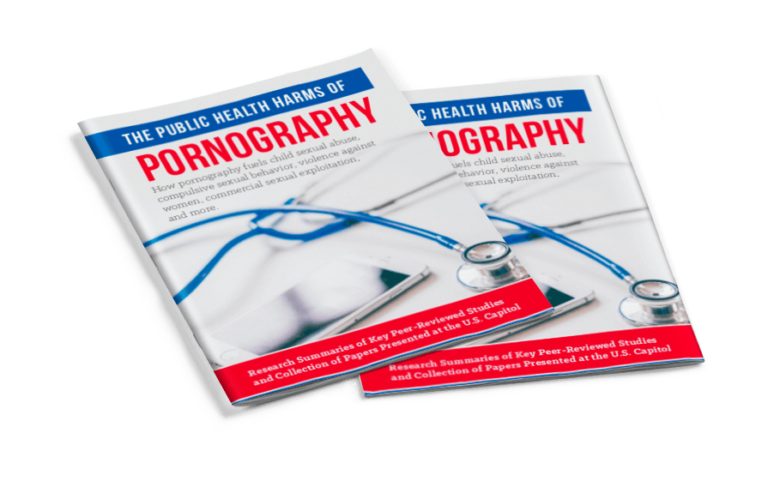

The 1986 Attorney General’s Commission on Pornography defined pornography as, “Material that is predominantly sexually explicit and intended primarily for the purpose of sexual arousal.”
Short answer: not necessarily. Current federal law prohibits distribution of obscene material (hardcore pornography) via the Internet, television (cable/satellite/broadcast and including hotel/motel pay channels), common carriers such as FedEx and UPS, U.S. mail, and wholesalers and retailers.
This fact may come as a surprise to the American public, since hardcore (and likely obscene) pornography is widely distributed on the Internet. This is because the U.S. Department of Justice (DOJ) has not enforced federal obscenity laws vigorously since the Reagan/Bush presidencies and has not commenced a new adult obscenity case against a major commercial distributor of “adult” obscenity for more than a decade. DOJ’s failure to uphold the law is responsible for the tidal wave hardcore pornography that has flooded the Internet.
The word “pornography,” however, is not a legal term, and is presumptively protected by the First Amendment unless shown to be obscene. If the pornography is found to be obscene in a court of law, it is not protected speech. A jury or judge(s) ultimately determines if the specific pornographic material meets the legal definition of obscenity.
In Miller v. California the Supreme Court established a three-part test to determine if material is obscene. Those tests are:
- Whether the average person, applying contemporary community standards would find that the work, taken as a whole, appeals to the prurient interest.
- Whether the average person, applying contemporary community standards would find that the work depicts or describes, in a patently offensive way, hardcore sexual conduct.
- Whether a reasonable person would find that the work, taken as a whole, lacks serious literary, artistic, political, or scientific value.
So, while not all pornography may be considered criminally obscene, much of the mainstream pornography found online today would qualify as obscenity if prosecuted. The Supreme Court has consistently ruled that obscenity, which includes hardcore pornography, is excluded from First Amendment protection.
In Miller v. California, 413 U.S. 15 (1973), the Court stated: “This much has been categorically settled by the Court, that obscene material is unprotected by the First Amendment” (23) and further elaborated “. . . to equate the free and robust exchange of ideas and political debate with commercial exploitation of obscene material demeans the grand conception of the First Amendment and its high purposes in the historic struggle for freedom. It is a ‘misuse of the great guarantees of free speech and free press’” (34-35).
For additional information see our Obscenity Law Fact Sheet.
In light of ethical requirements researchers are usually precluded from constructing experimental research designs which would prove pornography causes certain harms. For example, let’s say you wanted to do an experimental study that proved the harm of cigarette smoking on children. To conduct such a study, you could design an experiment in which 50 children were given cigarettes to smoke every day, and another 50 children were not permitted to smoke. However, such a study would be unethical since it would necessarily involve subjecting 50 of the study’s participants to potential harm (i.e., cigarette smoke). Consequently, in subject areas that deal with potential harms such as smoking, drug use, pornography use, sexual exploitation, etc., researchers are precluded from utilizing experimental design models that would demonstrate the effects of pornography use but could potentially harm the participants. Thus, most studies exploring the effects of pornography instead must use correlational models.
When experimental methods are not feasible to conduct and correlations exist, other sources of information can help to discern whether the correlation suggests causation, versus being false or the result of coincidence. For example, the experiential accounts of police, service providers, historical records, and tracking data showing certain trends to coincide with an increase in pornography availability may all be triangulated and—if consistently pointing to one conclusion, may collectively form compelling evidence of a causal relationship.
Over time, when a significant body of correlational studies are amassed, and corroborated by experiential and anecdotal accounts and trend data, in any given research area, there comes a point where the body of evidence can be said to prove a point of theory, even though there were few or no experimental studies. Put another way, no single correlation study could ever provide a “smoking gun” in an area of study, but the converging evidence of multiple correlational studies is used to establish evidence. Such is the case on the issue of the effect of violent media on children—that body of research all points in the same direction and so among experts it is considered a proved fact that violent media is harmful to children (see here, here, here, and here). Similarly, we believe the converging evidence concerning pornography proves its harm.
Just as many people consider gambling or food addiction as having a biological basis, with no moral overlay, it is time we looked at pornography with the same objective eye. A wide array of harms from pornography use have been objectively identified by research.
We advocate for sex-positive sex—that means sexuality that is based on respect, intimacy, connection, consent, mutual pleasure, and gender equity. It also means a sexuality that is not defined by people with commercial interests in defining and exploiting the sexual templates of others for their personal gain. Pornography is an industry that exploits those it uses to make its product, as well as those who consume it. Pornography does not portray healthy sexuality.
This is a myth. Research shows many police departments have for decades substantially undercounted reported rapes creating “paper” reductions of rape.
Additionally, converging evidence from peer-reviewed research finds that pornography consumption (especially of violent pornography) is associated with a broad array of sexually hostile attitudes and violent behaviors, including:
- Less egalitarian and more hostile sexist attitudes of men towards women
- Increased acceptance of rape myths
- Male sexual aggression against women (effects being more pronounced among men who are predisposed to sexual aggression, who consume pornography with higher frequency, or who use violent pornography, see here)
- Physical and verbal aggression among both male and female pornography consumers
- Greater likelihood of adolescents sexually harassing a peer (see also here)
- Adolescents perpetrating coercive and forced sexual behavior (i.e. child-on-child harmful sexual behavior (see also here)
- Physical and sexual victimization of adolescents
- Purchase of sex (see also here)
Take Action
Visa Must Follow Mastercard's Lead and Stop Processing Payments for Big Porn
Support our Lawsuits against Pornhub
Big Porn Receives 50% of Profits from Advertising
Share Your Story
Pressure the DOJ to Enforce Obscenity Law
Pornography Research


131,738
6x
Further Reading
How Can We End the Cycle of Child Exposure to Porn?
Research Spotlight: “Sexual Violence as a Sexual Script in Mainstream Online Pornography”
Why Do We Let Corporations Profit from Rape Videos?
No, Pornography Is Not Feminist.
Google Search: Driving the Pornography Industry’s Profits
Research Spotlight: “Sexual Violence as a Sexual Script in Mainstream Online Pornography”
Why Do We Let Corporations Profit from Rape Videos?
No, Pornography Is Not Feminist.
Google Search: Driving the Pornography Industry’s Profits
Research
Video Resources



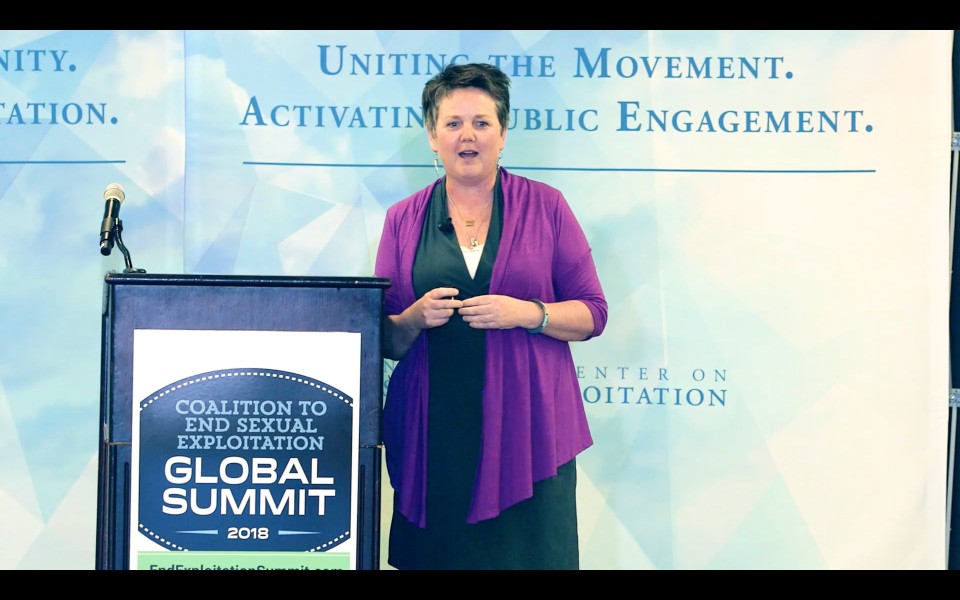
Subscribe to our YouTube channel for the latest webinars, presentations from experts, video podcasts, and more!
Audio Resources
Subscribe to the Ending Sexploitation Podcast today!
The Ending Sexploitation podcast decodes sexual harms and provides you with active solutions. We address the full spectrum of sexual exploitation, from sex trafficking to sexual violence, to rape culture, to pornography, and more. And better yet, we give you the tools to make a difference!